Instant Translation Without Equipment
Multilingual communication at large-audience events demands solutions that are scalable, flexible and quick to deploy. With distributed participants and different languages running simultaneously, it becomes essential to guarantee immediate access to information without adding logistical complexity.
- What it is: Machine translation with synthetic-voice audio accessible via smartphone.
- Who it's for: International events, conferences, distributed audiences.
- Key benefits: Scalability, no equipment required, rapid deployment.
- When it makes sense: Large-scale or hybrid events with multiple languages.
What does the service involve?
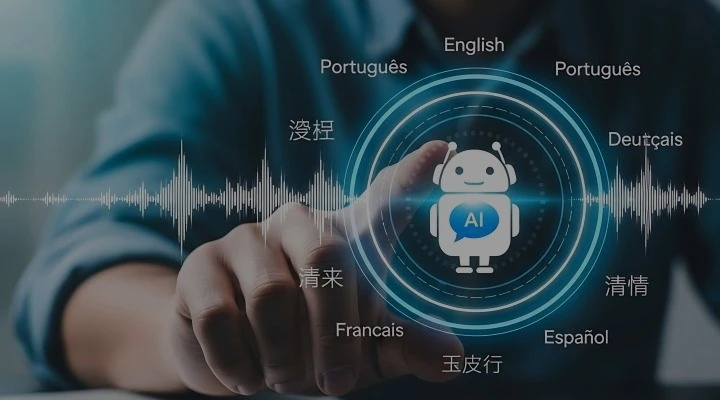
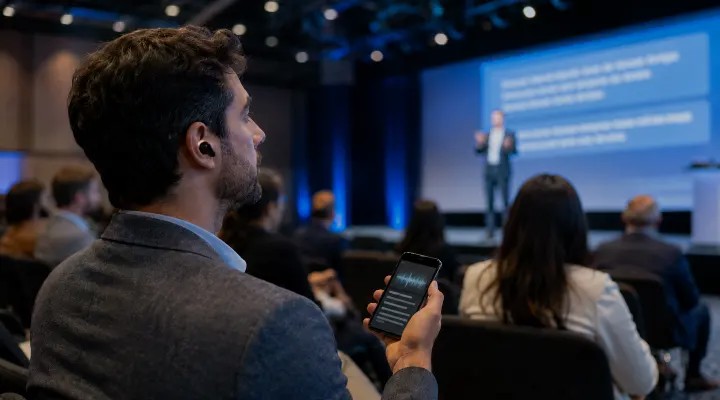
Synthetic voice for events consists of the automatic translation of speech in real time, with the result delivered as AI-generated audio. Participants access this translation directly on their own mobile devices. The system converts the original speech, applies machine translation and generates a synthesised audio version, allowing each user to listen to the content in their preferred language.
When it makes sense
This solution is ideal for contexts where scale and operational simplicity are critical factors.
- International conferences with a large number of participants.
- Hybrid events with both in-person and remote audiences.
- Parallel sessions with multiple languages.
- Events where distributing translation equipment/receivers is not feasible.
How it works
- The speaker's audio is captured in real time.
- The system converts speech into text using speech-to-text technology.
- Machine translation is applied to the content.
- Synthetic-voice audio is generated in the selected language.
- Participants access the translation through their smartphone.
Benefits vs Limitations
Benefits
- Highly scalable for large audiences.
- Eliminates the need for physical equipment.
- Reduces logistical and operational costs.
- Quick and simple to deploy.
- Aligned with ESG principles.
Limitations
- Lower quality than human interpreting in complex contexts.
- Synthetic voice may not convey emotional nuances.
- Reliance on internet connection and users' devices.
- Less suitable for critical or institutional events.
Criteria for choosing a supplier
To ensure a good experience, it is important to assess whether the supplier guarantees technical quality, stability and a smooth experience for participants.
- Quality of the machine translation and the synthetic voice.
- Stability of the mobile application.
- Latency in delivering the translated audio.
- Ease of access for participants (BYOD).
- Ability to support multiple languages simultaneously.
Concrete practical examples
At an international congress with hundreds of participants, the organisers opt for an app-based solution, allowing each participant to use their own smartphone to listen to the translation in their chosen language.
At a hybrid event, both remote and in-person participants access the translation through the same solution, ensuring a consistent experience without the need for additional equipment.
Why choose AP | PORTUGAL
AP | PORTUGAL acts as a Language Solutions Integrator, combining machine translation technology with expertise in events and multilingual communication.
- Deployment of scalable solutions for international events.
- Integration between technology, communication and user experience.
- Ability to adapt to different event formats.
- An approach geared towards efficiency, innovation and sustainability.
Frequently Asked Questions
Is the translation done in real time?
Yes, the translated audio is generated automatically during the event.
Do I need any specific equipment?
No. Participants use their own smartphone.
Is the voice human?
No, it is a synthetic voice generated by artificial intelligence.
Does this solution replace interpreters?
It depends on the context. For low- or medium-risk events it may be sufficient, but for critical contexts human interpreting is recommended.
Don't leave room for second interpretations!
"Please send a big 'obrigada' to the interpreters. They were great."
Amelia Peters
#AI voice translation for events #real-time speech translation app #synthetic voice translation #smartphone live translation